Falling apart – mixed marriages in ‘My Name is…’
May 8 2014
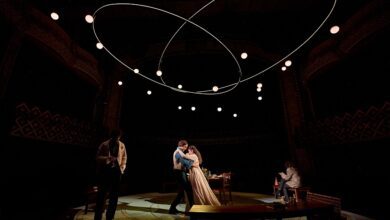
Based on a real life story, a new play examines what happens to a husband and wife as their relationship breaks down and their daughter becomes a cultural symbol…
LOVE can be such a powerful drug that it can sometimes blind people to the cultural and racial sensitivities of a couple’s situation.
For some it’s a unifying force, for others it can be a burden too great when the love begins to falter.
A new play by Sudha Bhuchar, the founder and artistic co-director of Tamasha, titled, “My Name is…” explores the experiences of two people marrying across a religious and ethnic divide by looking at the real people behind a cause celebre from 2006.
It isn’t at all preachy or political but tells a very moving and insightful story of how two people came apart, quite regardless of their culture and ethnicity and how their daughter unwittingly got caught in the middle.
Bhuchar told www.orangered-oyster-271411.hostingersite.com: “It’s a universal story of love and family breakdown, of course complicated by cultural factors and a child caught between two parents – I wanted to show the human side of it.”
Scottish schoolgirl 12-year-old Molly/Misbah Campbell went missing one day and her mother, who was physically separated from Molly’s Pakistani’s father, Sajad, presumed he had abducted her.
Molly or Misbah as she was known there, turned up in front of the media in Pakistan a couple of days later, saying she liked it in Lahore and wanted to stay with her father.
The mass media soon portrayed it as a clash of cultures, taking sides and either denouncing Sajad as a rabid Islamist, simply because he had a long beard or Molly’s mum, Louise, as an unfit and deranged mother.
Emotionally and factually, the truth was a lot more complex as Bhuchar discovered for herself when she interviewed the three of them all separately two years after the original imbroglio.
On the face of it, “My Name is…” is really a family drama about a husband and a wife falling out of love and their daughter being forced to make unenviable choices, which were amplified by the mass media and packaged as a ‘conflict’.
The cultural baggage was just that – paraphernalia that could be left behind as two people grew apart for no other reason than they became older and changed.
In the beginning it is a tender, charming romance between a feisty, ballsy teenager Suzy (just 16) in the play (Louise in real life) and very much a young man about town, track-suit wearing gym-loving Farhan (Sajad in real life).
A certain cultural curiosity, it could be argued, pulled them close and bound them as they began a different life together, but slowly cracks that become as wide as continents forced them to seek an existence apart.
It’s both where Bhuchar’s own story of making “My Name is…” begins and ends.
She jumped on a plane to Lahore to talk to Sajad and Molly, a while after the furore.
“I read this article by Adrian Levy & Cathy Scott-Clark (South Asian specialists, www.orangered-oyster-271411.hostingersite.com on their latest book, “The Siege”) and I got interested in the story behind the story.
“Adrian was very helpful and put me in touch and it was a completely personal quest. I phoned Sajad and he was quite open and he said… ‘Come’.”
Bhuchar, who is married to a man of Pakistani heritage, went to Lahore on a family trip, with her husband and two sons.
“We took Sajad at his word, so if it didn’t work out, it would still be a holiday,” she explained.
Both Sajad and Molly were very expressive and communicative and it’s clear Bhuchar felt a care and sympathy for two people whose lives for a while had been lived under an almost relentless media spotlight.
Bhuchar recorded their conversations but wasn’t sure how exactly she was going to use the material.
“I thought I was going to write a fictional play around the research.”
Talking to Louise proved harder initially – she wasn’t returning Bhuchar’s calls and may have been wary about her intentions.
Then, there was a significant breakthrough.
[captionpix imgsrc="https://asianculturevulture.com/wp-content/uploads/2014/05/mynameiserealpeople.jpg " captiontext="Kiran Sonia Sawar (Ghazala/Gaby), Sudha Bhuchar, Louise, Molly" width="300" imgalt="ACV" imgtitle="ACV" align="right]“I think Molly said: ‘This woman (Bhuchar) came down, why don’t you speak to her, why don’t you give your side of the story?’.”
Bhuchar travelled to Stornoway, the main town on the Isle of Lewes, in the Outer Hebrides, to meet Louise and the two struck up a lasting friendship which continues.
“She’s been a great solace to me. In the last five years we have lost two people in our family (Sudha’s brother and mother), and we have met variously and talked.”
Initially, Bhuchar thought she would write a drama along conventional lines, utilising her taped conversations.
“I thought I was going to write a fictional play based around the research,” revealed Bhuchar.
“I kept leaving it and things were happening in my life and there were other projects and I had a deep sense of responsibility because they were real people and I was drawn to them and their words.”
This is the key in explaining why she decided to use the actual words from her taped recordings to construct the drama.
Virtually every line you hear in “My Name is…” was actually uttered to Bhuchar by the three central characters.
She has only been creative in the way the characters address, or at times talk over, each other.
What you get then is a feel for the characters as real people – they become far more than actors in a play.
“It really struck me – what I wanted to offer is the way they speak, especially Molly, she goes in and out of Urdu and English in her Scottish accent and the music of it is beautiful and the mother is quite poetic and also weaves in and out of Pakistani Scottish, you can’t make it up and I can’t write that.”
On Friday (May 2), Louise and Molly saw “My Name is…” together for a second time at the Arcola Theatre in Dalston, where it premiered last Wednesday (April 30).
They told www.orangered-oyster-271411.hostingersite.com the first time was incredibly “emotional”, like a “throwback into time”.
“We liked it a lot,” said Louise. “It showed exactly what happened.”
Molly added: “It was really like a time machine and going back at looking at ourselves.”
Bhuchar said: “I feel it’s a small play with a big canvas. This is multiculturalism lived through people and this is what I am interested in.”
The range and depth of the issues dealt with in the play are astonishing – but it never gets heavy or overbearing, or even remotely dense.
The tone is natural and easy – just as it might be if you ever talked to Molly or Louise or Sajad about their lives.
Bhuchar stated: “They wouldn’t say Afghanistan (or Iraq) was why their marriage broke down and nor was it Islam.
“This is about people feeling pressurised in themselves. They went into this marriage trying to make it work.
“Mixed marriages have more pressure, especially where one person is trying hard to adopt the role expected of them.”
Louise not only converted but learnt Arabic and was more knowledgeable about the Qur’an and Islamic practice than many born into the faith. She wore a veil and then a burqa.
Bhuchar explained: “She was really on a crest of wave as she herself said (in the play too): ‘They put me on a pedestal and the pedestal got higher and higher and it was Shabash (wonderful) sister.”
It proved to be her undoing to some degree, especially as her relationship with Sajad became more strained, not because of that, but more general family and personal relations.
The play covers this well, showing that sometimes in pleasing others, you can actually dismantle yourself.
In the broad brush strokes of a media narrative, one side had to be good and the other bad. Real life isn’t so simple.
“This was a personal story but it was played out so publically and the media used it to discuss other agendas," said Bhuchar.
“I can’t emphasise this enough, it’s a universal thing.
[captionpix imgsrc="https://asianculturevulture.com/wp-content/uploads/2014/05/mynameisgoodall.jpg " captiontext="As above, Karen Bartke (Suzy/Sajida) and kneeling Umar Ahmed (Farhan) and Arun Ghosh (composer/sound designer)" width="300" imgalt="ACV" imgtitle="ACV" align="right]“What I really hope, if anything, is that the play will promote a more nuanced dialogue.”
The play will go to Glasgow at the end of this month and it promises to be another interesting moment in this continuing “dialogue”.
“All the actors are Scottish and all the Asian actors we auditioned said this was a really important story for them and it resonated on a very personal level.”
The difficulty Bhuchar had in securing a producer partner are dealt in another earlier news story. It's here.
It’s an exciting time for Bhuchar and it’s going to be an interesting time for anyone who is passionate about innovative and arresting drama.
Bhuchar will be leaving Tamasha as artistic director after founding the company more than 25 years ago. Her other artistic co-director and founder Kristine Landon-Smith left for pastures new in Australia in 2012.
She intends to write more and will be handing over the reins to Fin Kennedy, who is also co-artistic director at present.
“I want to focus more on myself as an artist and hopefully taking my experience and helping people where I can,” revealed Bhuchar. “I’d love to get back closer to the work and be led a bit more by ideas.”
She is already developing two plays – one about Asian men and heart problems, called “Golden Hearts” and a stage creation from the book, “White Mughals” with Tim Supple from a very progressive and exciting outfit called Dash Arts.
She knows full well there are mutterings about one of the country’s most iconic Asian theatre companies soon being led by a non-Asian. Kennedy will become sole artistic director of Tamasha in 2015.
“I understand people’s worries but I hate this reductive conversation about the colour of his skin.
“He understands the responsibility of Tamasha retaining its British Asian anchor. He has an incredible history of making work that he really believes in – and he really believes you have the power of transcending your cultural borders.
“He has made 10 years of work at Mulberry School (in Tower Hamlets, London) working with a school that is almost 100 per cent British Bengali girls and has written new plays for them and they have taken them up to Edinburgh.
“We had a very open and robust process, and there were a huge number of applications, and he was the best person for the job.”
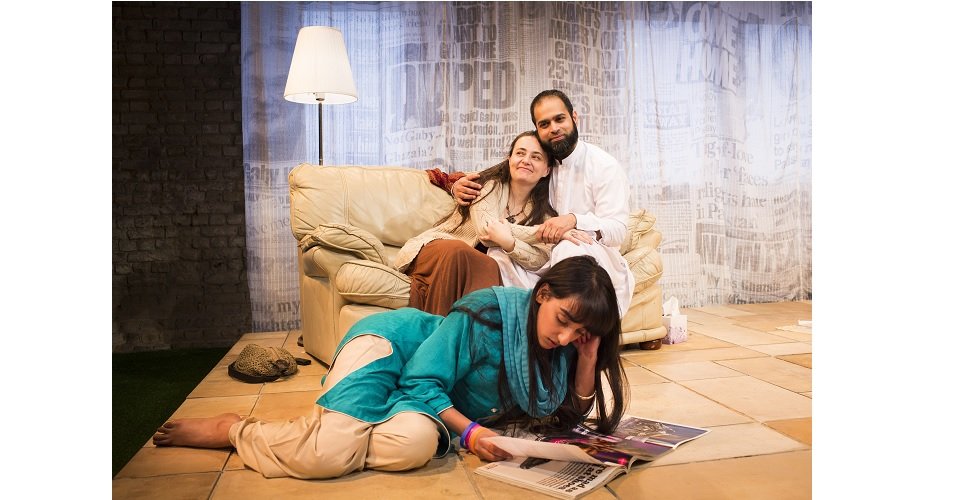
Main picture: Kiran Sonia Sawar (Ghazala/Gaby), Karen Bartke (Sadjia/Suzy) and Umar Ahmed (Farhan) in ‘My Name is…’©Helen Maybanks
Listings
- “My Name is…” on at Arcola Theatre, London E8 untill May 24
- At the Tron theatre, Glasgow from May29-31 and then on tour autumn, check tour dates on website
- www.tamasha.org.uk