
‘The Enlightened Manager’ – training the mind to get the best out of yourself and colleagues
Successful Indian entrepreneur & FT writer go on a journey…
THIS ISN’T LIKE any book you might have encountered in this field before – it’s about management and a lot more.
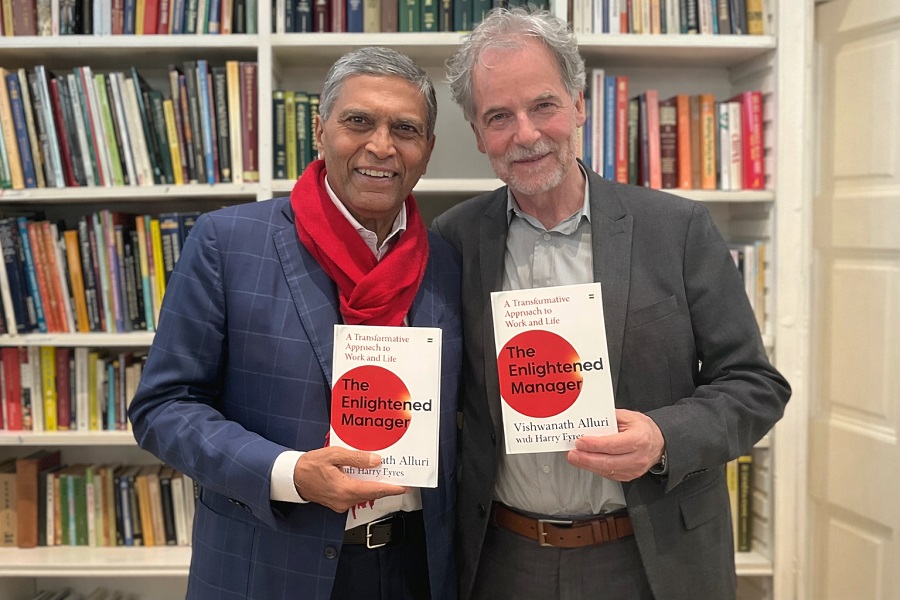
‘The Enlightened Manager’ – A Transformative Approach to Work and Life’ is a book written by Indian entrepreneur Vishwanath (‘Vish’) Alluri with Harry Eyres, a journalist and commentator with the FT.
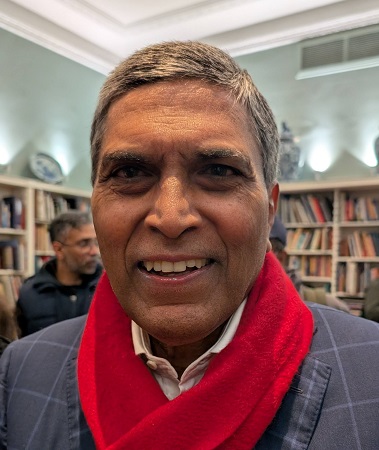
When www.asianculturevulture.com met Alluri over Zoom from his home in Hyderabad, he said the book has more the structure and tone of ‘Zen and the Art of Motorcycle Maintenance’ by Robert M Pirsig. Published in 1974, it’s a novel about a father and son travelling across the US (Minnesota to north California) on a motorcycle in 1968. There are philosophical and spiritual digressions, and it was a book that had a considerable impact on artists and the counter-culture of the country at the time.
Alluri felt the novel asks big questions in the way his does too – and his offers humble and micro-solutions, perhaps contained within a larger framework of a change in how you think.
“It’s about how you manage life, it’s not just about managing a business,” he pointed out talking about his ‘The Enlightened Manager’.
Alluri has a great story to tell and it drops in excerpts in this and the emphasis in ‘The Enlightened Manager’ is more about how you approach life and ‘manage’ issues and challenges.
While it is set with in the context of business, there is something of a more general conversation between the narrator and several characters who appear throughout the book.
You might argue that Alluri himself is a successful version – even vision – perhaps of Asian business success, influenced by Eastern or Indian wisdom.
Coming from a modest rural background – with family dedicated to the land, public service and politics (mostly communist, he added, humorously), he trained as an accountant, and built companies he came to run. One engineering venture sold to Danish conglomerate Ramboll, while another communication platform called IMImobile was acquired by global IT giants, Cisco. Both deals were multi-million exits.
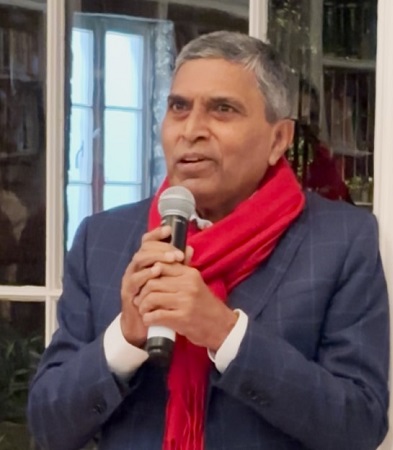
Much of Alluri’s thinking is influenced by Indian thinker Jiddu Krishnamurti (1895-1986).
Initially Krishnamurti, who was born in Madanapalle in present day Andhra Pradesh – was ordained a ‘World Teacher’ by the Theosophical Society – a spiritual movement that tried to bridge a gap between Eastern systems of thought, prevalent in Hinduism & Buddhism and more European non-Christian (even Pagan or pre-Christian) forms of spirituality with science and rationality.
Krishnamurti broke free of the Theosophical Society – the idea of being ‘a teacher’ or someone who anyone would follow in a traditional or pedagogical leadership model was an anathema to him.
Alluri never met Krishnamurti but greatly admires his approach to life and his thinking might be applied to modern life and management. Alluri remains the secretary of the Krishnamurti Foundation in India.
This book is very accessible and the different characters the narrators encounter tell anecdotes or have little stories that impart knowledge and experience.
It examines how the mind approaches what we might consider as ‘problems’, ‘dilemmas’ or ‘issues’.
So, while the outward form of many people’s lives are consumed by ‘business’, or their work – adjusting how your mind works can be beneficial and will show new and different paths and provide ‘solutions’ to problems – or the problems won’t be that all.
“It’s like when you’re driving a car on a highway, you know how the car operates and you know whether to apply the brakes or the accelerator – if you understand how your mind functions you can start to change the way you approach management challenges. “If there’s a corner coming, you know how to steer the corner,” Alluri outlined in his metaphor.
So you must know yourself to understand the present and through the present, the past. From the known present, the hidden layers of the past are discovered and this discovery is liberating and creative’ p49 – (‘The Enlightened Manager, Harper Business 2025)
When faced with management issues and challenges, this book will help you come to think about them in such a way that they should become less daunting or formidable.
At the launch in London late last year, Alluri and co-author Eyres emphasised how the book should be read.
In some ways, it’s better to approach ‘The Enlightened Manager’ in the same way you would a book of poetry – you don’t read a book of poetry the way you read a novel; similarly, the book is meant to be read in spurts, not in long sittings and part of the philosophy is to let these thoughts coagulate in your mind.
Alluri talks about “coffee darshan” – this is simply where you take a moment to have for yourself; he recommends spending a few minutes with your favourite beverage and simple contemplation every day, if you can manage it or more so when you are busy and/or stressed. (Darshan is a Sanskrit term for vision/sight and is often used to describe a visit to a temple and contemplation before a deity.)
Alluri also said he takes inspiration from the Don Camillo and Peppone stories – published in Italy just after the second world war and written by Giovanni Guareschi – they chronicle the fictious exchanges between a Catholic priest and a Communist mayor – two people whom you imagine would have little in common. While they do argue, they also have a shared interest in the wellbeing of the people around them and both were part of the Italian resistance fighting fascism and Mussolini at that time.

Again, it is about the nature of the exchanges – not the dialogue itself – though by extension, Alluri is also interested in how people live and balance their interests and passions – alongside or as part of their work – to get the most from life and their business.
“There’s no ‘I’ in the book, I don’t want to look like a big master for pontificating. I am not an expert.Self-deprecation is better,” he chuckled.
The book is divided into chapters – some seem very obvious – ‘Investors’, ‘Employees’, ‘Productivity’, while ‘The Unique Feel of Roger Federer’, ‘The Friend on the Bench’ (a character in ‘The Enlightened Manager’ gives you some idea of its quirkiness and depth).
It’s not that often you come across an author who has quite a laid back attitude to their work – he doesn’t really engage with the question of why you should/must read it. It’s almost refreshing – caught up in tumble of ‘promotional activity’ as we are – www.asianculturevulture.com always tries to look for something beyond.
“It’s – if this book interests you – then read it. This book just happened. It is dedicated to all those readers who happen to pick it up with no expectations or preconceptions.”
Sweet.
More
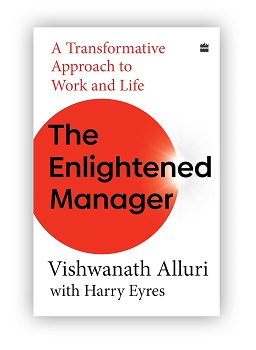
The Enlightened Manager , Harper Business, November 2025