‘A Story of South Asian Art – Mrinalini Mukherjee and Her Circle’ – Fine show, final days…
Don’t delay if you are keen to get close to work which came out of India and absorbed both European influences alongside a very Indian aesthetic…
WELL-STRUCTURED and designed, ‘Mrinalini Mukherjee and Her Circle’ is well worth seeing, as it enters its last eight days on display at the Royal Academy in Piccadilly, London.
Subtitled ‘A Story of South Asian Art’, Mukherjee’s story essentially starts with her father – Benode Behari Mukherjee, who studied at the art school of Visva-Bharati University in Santiniketan.
This is the world famous educational institution created by Indian polymath and Nobel Literature Prize winner Rabindranath Tagore(1861-1941, winning the Nobel Prize for Literature in 1913).
The philosophy here was very different – especially to the school and art school system that had developed under the British Raj in the late Victorian and early 20th century period.
Classes were held outside and there was a huge appreciation and respect for nature and its processes.
Students were encouraged to absorb and explore their natural surroundings – the school building themselves were built from natural materials and the grounds were open and covered in trees.
It was here that Mrinalini’s father, Benode Behari Mukherjee, developed his art practice – attending Kala Bhavana, the art section and the university section of Santiniketan, known as Visva Bharati University.
Partially blind but inspired by the university’s ethos and lack of formal boundaries in studying and the practice of art itself, Mukherjee senior began to give a new and further direction to Indian art practice.
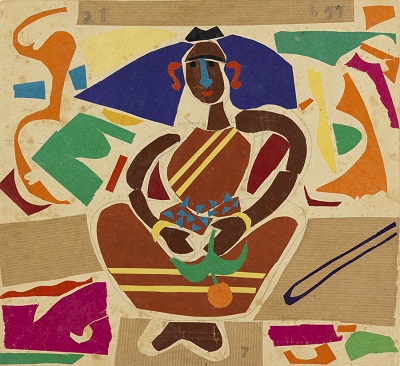
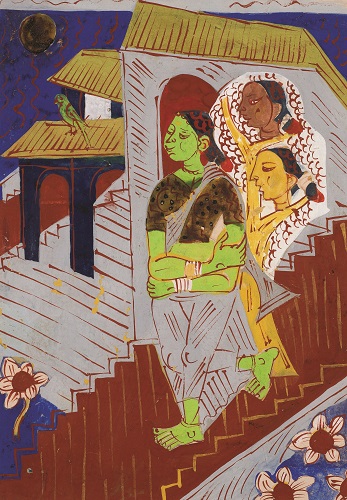
Along with his wife Leela Mukherjee and students, new work was produced and ‘Life of Medieval Saints’ (1947) signalled this.
A mural with feint figures – its style is evocative of different traditions – some newer to modern Indian art – others there for almost a Millennium.
The Royal Academy, in its guide to the exhibition by Cleo Roberts-Komireddi, for example, refers to “Persian miniatures” (13th-17th Century) and “Chola Bronzes” (848CE-1279CE) evoked by ‘Life of Medieval Saints’.
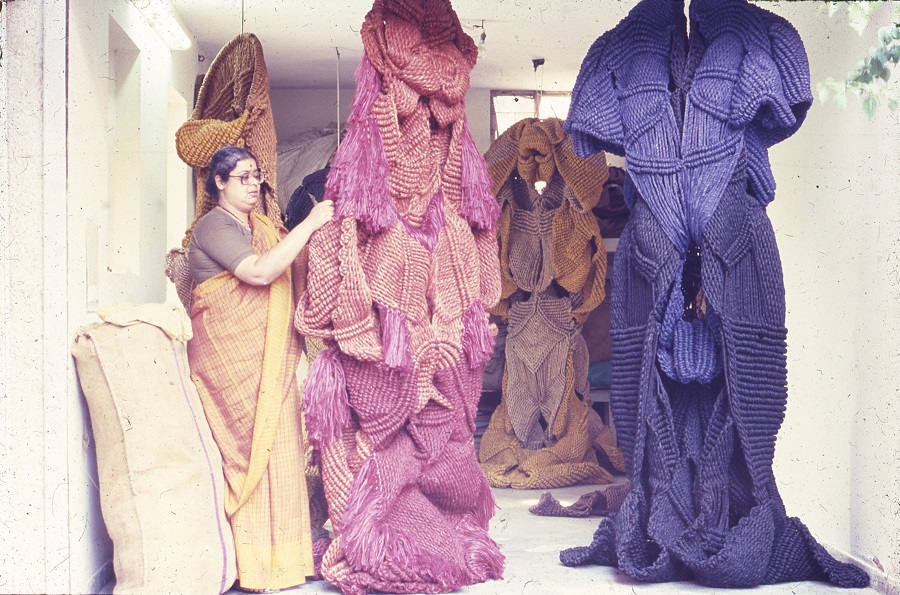
Mrinalini took up art practice and started out by helping her father especially and the exhibition charts her development through her lifetime as a precocious 16-year-old at Faculty of Art at the Maharaja Sayajirao University in Baroda (now Vadodara)in 1965 to the 2000s when she starts producing bronzes.
What the exhibition also does is place her and her friends – or circle – in a narrative of influences, experiences and changing aesthetics…
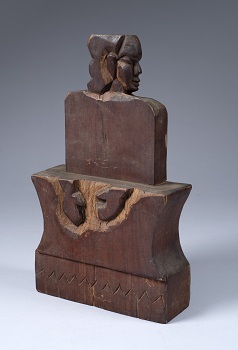
One of the most striking aspects is the ‘elevation’ of tribal or indigenous art practice – several artists among her circle began to incorporate it and pay artistic homage – at a time when European and Western art ideals were generally predominant and prevailing – India might have been free since 1947 but its mind – if we can put it like that – remained captive to hierarchy and judgement based on western preoccupations.
These artists here, along with Mrinalini, began to offer a more egalitarian exchange – or at least afford a respect and consideration that had been deliberately diminished by Colonialism and its so-called ‘civilising’ project.
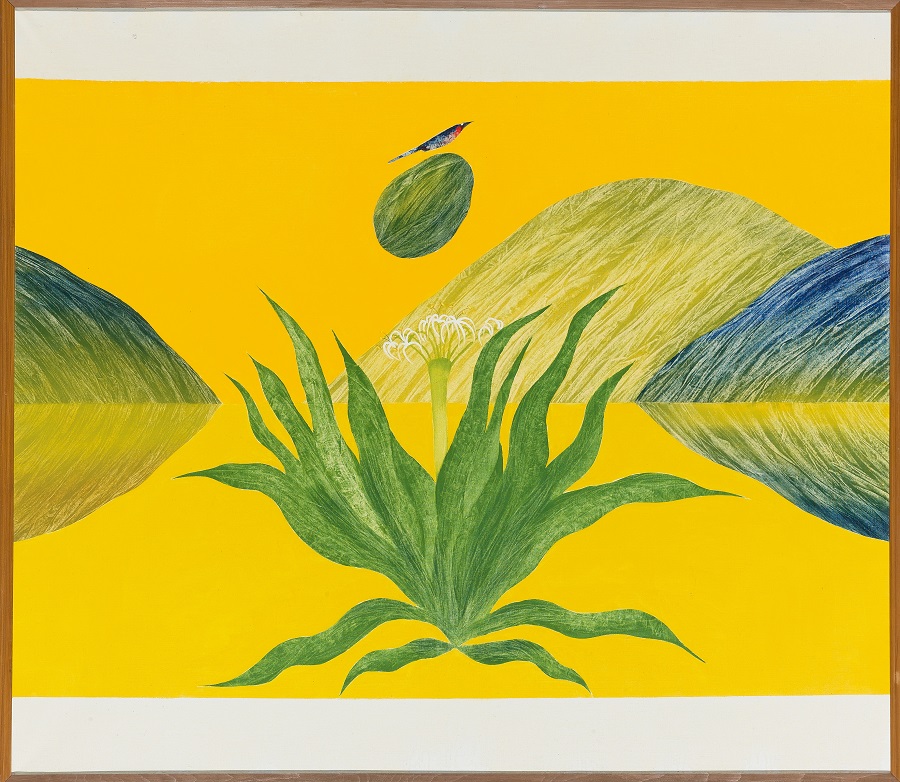
The works of two other artists are also very prominent in this exhibition – Jagdish Swaminathan (1928-1994) and Gulammohammad Sheikh – who remains one of the foremost contemporary Indian artists of the day.
There’s enough here for a good 90 minutes or so, it’s rich and varied but not overwhelming and the artwork is thematically and chronologically structured, so you come away with an appreciation of how themes developed and continued from the early 20th century into this one or near this Millennium.
ACV rating: **** (out of five)
All images Courtesy of the Royal Academy – do not reproduce/use without prior permission
Listing
Mrinalini Mukherjee and Her Circle, The Royal Academy of Arts, Burlington House, Piccadilly London W1 0BD until Tuesday, February 24
A Story of South Asian Art | Royal Academy of Arts
Exhibition organised by the Royal Academy of Arts, in partnership with The Hepworth Wakefield.
The exhibition transfers to The Hepworth Wakefield from May 23-November 1 at The Hepworth Wakefield, Gallery Walk, Wakefield, West Yorkshire WF1 5 AW