Light and laughter in the music of Prince Rama Varma
April 29 2014
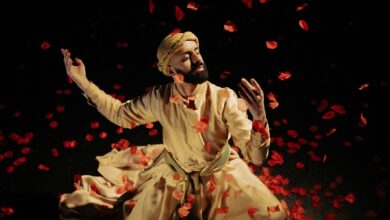
INDIAN royalty he may be, but Prince Rama Varma of Travencore (Kerala) is as unpretentious as they come.
And that’s saying something because as an artiste of Carnatic music, the classical South Indian style, a certain austerity and seriousness is demanded.
Indeed, Prince Varma dispensed with such formalities, cracked some memorable jokes, joshed with the audience at the Purcell Room at the South Bank on Friday (April 25)and even sang a tune popular with children.
As he pointed out at his concert, the singing of a ‘children’s song’, would just be too far ‘beneath’ many a Carnatic vocal practitioner – at least those of a professional and very serious demeanour.
But there was nothing amateur about Prince Varma, he sang with great precision and passion, winning the hearts of those who are familiar with the form, as well as those new to it.
In a Q&A with eminent music journalist Peter Culshaw afterwards, Prince Varma explained the intricacies and background behind Carnatic music. Unlike its Hindustani counterpart, the classical musical heritage of the north of India, Carnatic does not enjoy the same patronage, especially abroad or in the West.
But at the same time it possesses the same vitality and passion and Prince Varma compared it to jazz.
To the purist, his range of songs, from the classic to the more popular, and his jocular manner might be something of an affront, but to ordinary mortals, it’s a delight and enlightening.
Descended from the royal family of Travencore and a ruler regarded as one of the most brilliant men of his age, Maharajah Swathi Thirunal Rama Varma, the nineteenth century king was a musician, composer, author and lawmaker extraordinaire.
Asked by Culshaw what his relationship to Maharajah Swathi Thirunal Rama Varma was, Prince Varma quipped he was simply, “descended” and he would “decompose” on his death. More seriously, he said the works left by Swathi were deeply impressive and that was an objective assessment, though people rarely saw it that way.
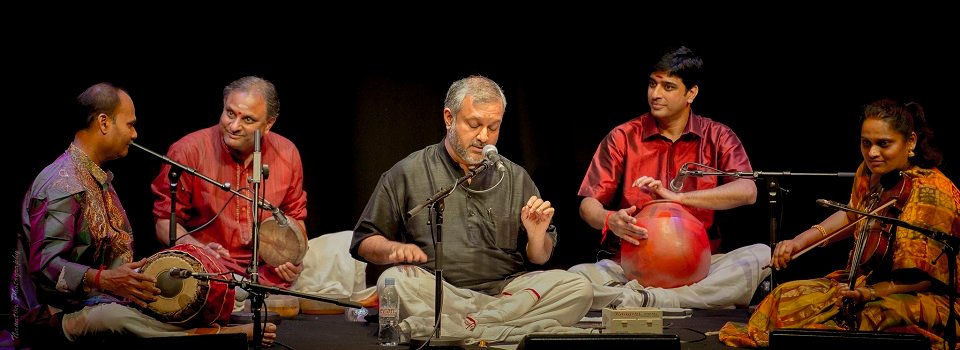
Mention too should also be made of Jyotsna Srikanth, the accompanying violinist and concert organiser through Dhruv Arts. As always, she was an engaging musical presence and Prince Varma said it had been a condition of playing in London to have M Balachandar on mridangam, a two-sided drum, and RN Prakash on Khanjira, a one sided drum.
[captionpix imgsrc=”http://orangered-oyster-271411.hostingersite.com/wp-content/uploads/2014/04/Peter-Prince-Jyotsnaadjusted.jpg” captiontext=”Peter Culshaw quizzes Prince Rama Varma and Jyotsna Srikanth” width=”500″ imgalt=”ACV” imgtitle=”ACV” align=”right]Last but not least and potentially, a star in his own right was RR Prathap, who performed a sustained virtuoso section on ghatam, the clay pot.
Such was his sensational exhibition of talent and fevered display, he had to remove his shirt to which Prince Varma remarked Prathap was not too unlike footballers when they score a stupendous goal.
Furthermore, it would not have been a surprise to see a few women in the audience visibly swoon when the handsome, stately Prathap discarded his shirt.
Now, what an austere Carnatic maestro would have made of that…one can only wonder…
Main picture: (L-R) M Balachandar on mridangam; RN Prakash on Khanjiral; Prince Rama Varma, vocalist, RR Prathap on ghatam; Jysotna Srikanth, violin