
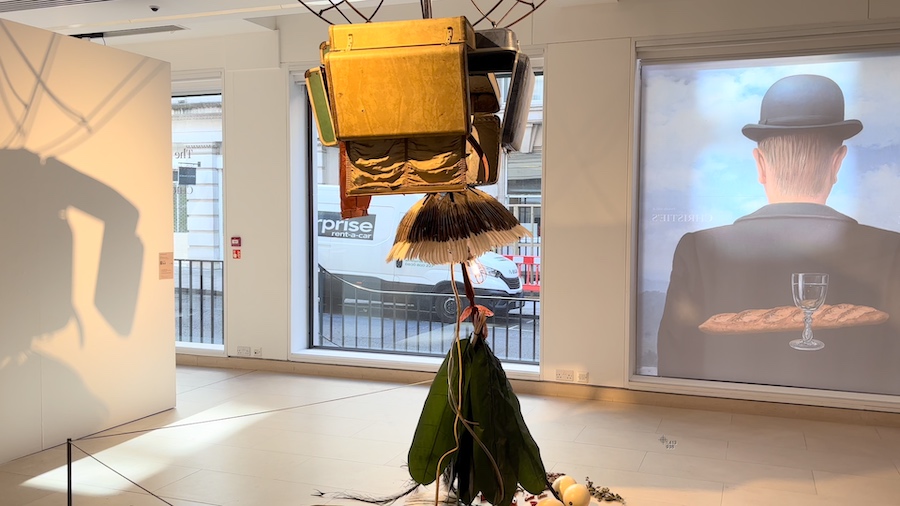
‘The Meeting Ground’ – Kiran Nadar’s summer gift to London about to depart
Range and depth – deserves more exhibition time and viewing… Our review below
🎨 Christie’s London free summer exhibition – ‘The Meeting Ground‘ – Scenes from the KNMA Collection ends this week…
🎨 Collection on display is from Kiran Nadar Museum of Art (KNMA)
🎨 Indian personal collector Kiran Nadar is building India’s largest art space – new gallery building and art centre expected to open 2028 in New Delhi
🎨 In this exhibition, 67 artists with around 180 works on display
🎨 See our Instgram/YouTube Reels on exhibition
🎨 Final free guided (60 minute) tour is on Thursday (August 20)
KIRAN NADAR is increasingly the face of Indian art, globally.
If you attended Kochi Biennale (December 2025-March 2026), as we did and are connected to the art world, you will know that she was one of the Biennale sponsors and that her own estimated 14K strong collection will soon come to be housed in a million square foot plus art gallery/cultural centre still being built in New Delhi.
It will be one of the largest art spaces of its kind in Asia – and will be the largest private gallery in India. While in the planning for some years now, it is expected to be unveiled in 2028 and is some 60 per cent complete.
This current exhibition features 60 artists and around 180 works, and includes work from artists across the whole of South Asia – it is not confined to India alone.
Thematically organised into different but sometimes overlapping sections in different rooms, for www.asianculturevulture.com, one room and its content deserves an exhibition all to itself.
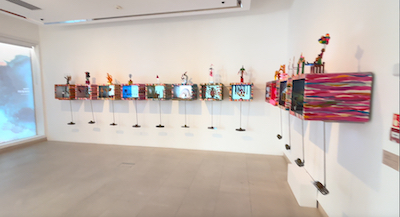
‘Unfinished Homelands’ is about artists and changing borders and roles from Empire through to Independence and then Partition, the creation of Bangladesh to continuing contemporary conversations about identity, home and art practice as a minority in the west, even. This is well worth picking up and highlighting in the future, we believe.
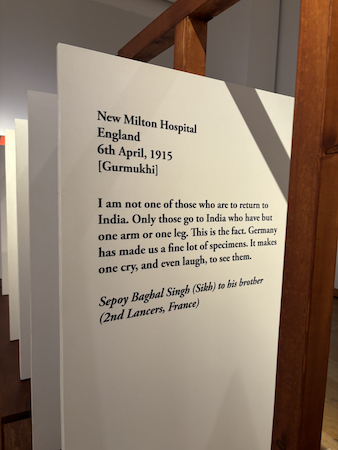
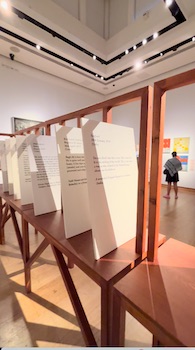
Letters once penned by British Indian Army soldiers and now translated into English and displayed clearly in the centre of the room are a powerful reminder that The Raj held sway across different communities and in the First World War, helped Britain and the Allies to defeat the Germans. More than 1.4 million are recorded to have contributed to that war effort with nearly 900K involved in actual battles. A few thousand Indian soldiers also convalesced in Brighton Pavilion and other smaller centres designated to treat injured troops. Here, some of the letters penned at the time – complete with dates and location – are prominently displayed and form a powerful collective memory of sacrifice, duty and trauma. The love and longing of home is most apparent and touching.
There is also a section devoted in this space to Bengali/Bangladeshi artists, some of whom were born in Imperial India, then produced work in East Pakistan, which then become Bangladesh, following liberation and separation from what was West Pakistan at the time. Of these artists some settled abroad (in the west) and assumed a different national identity. In this part, you can see work by Zainul Abedin (1914-76), Anwar Shemza (1928-85), American India-born Zarina Hashmi (1937-2020), Fn Souza (1924-2002), and Bani Abidi, born In Lahore, Pakistan and now resident in Berlin.
In this part, there is also an MF Husain work – one of India’s best-known artists who was driven to self-imposed exile – first in the Middle East and then in London, following controversies over some of his works in India.
Another interesting feature of ‘The Meeting Ground’ is the way that it incorporates tribal and folk art – not as something separate and/or distinct but within the very fabric of contemporary art practice – something that looks set to continue in the new gallery in New Delhi.
Emblematic and used in marketing promotion materials for the exhibition, is the ancient carpet beating video work – ‘Interference’ – this shows a 200 year-old carpet being beaten and as the dust plumes form – the soundscape is of gurgling water. Shot in 4K and displayed on a vast screen – what seems like it is 10ft+ tall, LN Tallur’s 2019 creation made in partnership with Junagadh Museum in Gujarat, is work that sticks in the memory. If only carpets could talk…
Also of continuing interest is the work of Kulpreet Singh – the farmer/artist who had his latest work displayed at Kochi Biennale and then was brought to the Hayward Gallery in ‘Indelible Black Marks‘. The continuing theme of harvest burning is reflected in kurtas made of actual stubble and initially viewed, look like retro football tops.
There is a huge and innovative range here – there are many well-known figures from Indian and South Asian art – among them: SH Raza, Jeram Patel, KCS Paniker, KG Subramanyan and K Ramanujam, whose works occupy a particular space and are in dialogue in ‘Unfinished Homelands’ section, reflecting the period in the 1950s when the Bombay Progressive Artists’ Group emerged and had a huge influence on young artists of the time.
The generation of new artists also appear: Neha Choksi, LN Tallur and Simryn Gill.
Kiran Nadar told Christie’s: “‘The Meeting Ground’ reflects both the depth of the collection and the evolving role of KNMA as a multidisciplinary cultural institution speaking with the world from South Asia.
“International engagement is a pillar of our vision, opening up new frameworks for dialogue and scholarship.”
In February, KNMA announced that it was appointing Manuel Rabate as its first new CEO and director. He previously ran the Louvre Abu Dhabi for 10 years and can be seen talking about this exhibition in Christie’s short film about the exhibition (see below).
Anthea Peers, President, Christie’s EMEA hailed ‘The Meeting Ground’ as a “landmark exhibition” . She said: “KNMA is a leading museum in India with an important place in the development and presentation of modern and contemporary art from South Asia.
“It’s been a real pleasure collaborating with Kiran Nadar and her team on bringing this project to life here in London.”
Akansha Rastogi, lead curator and associate director, Visual Arts, KNMA, notes: “The region of South Asia is connected through a shared visual history and deep cultural resonances, and the exhibition presents these rich and complex conversations through an intergenerational mix of artists.”
She added that the exhibition gave people an idea of how the new gallery might be arranged.
Damian Vesey, international specialist, South Asian modern and contemporary art, at Christie’s, adds: “This exhibition marks the first time Christie’s London has dedicated its summer exhibition to South Asia, as well as to a single institution.”
Vesey has been conducting free public tours – the last of which is tomorrow (Thursday, August 20).
This exhibition is curated by is curated by Rastogi along with Preeti Bahadur, Avijna Bhattacharya, Premjish Achari and Srinivas Aditya Mopidevi. They have been responsible for the respective sections and creating the ‘dialogues’ among the artists.
This is the fourth such summer public exhibition organised by Christie’s. The previous editions have covered art from the Middle East.
Christie’s staff were unavailable for comment to camera on the day of acv’s visit.
Listing
The Meeting Ground – Scenes from the KNMA Collection, Christie’s, 8 King Street, St James’s, London SW1Y 6QT
9am-5pm until Friday August 21
Last guided tour – August 20 (3pm-4pm)
More info/booking tour: https://www.christies.com/events/knma-exhibition-meeting-ground?pid=ct:still|lt:ldn|pr:london_summer_season|ll:no|pa:meeting_ground|de:slp#exhibition
https://www.instagram.com/p/DcOLAZfub81
More caption details will be added…