‘Arcadia’ – Stoppard play is powerful and evocative
This is one of great English playwright Tom Stoppard’s* best-known works, which has been revived by The Old Vic in London and is a hit with audiences. Actor Prasanna Puwanaraja plays one of the leading parts…
By Suman Bhuchar
SET in two parallel timelines, in a large country house in Derbyshire – ‘Arcadia’ is a play about ideas and appeals both to the head and the heart.

In 1809 at Sidley Park, Septimus Hodge (Seamus Dillane) is a tutor to a child prodigy – 13 year old Lady Thomasina Coverly (Isis Hainsworth), teaching her mathematics, physics, and languages. Their relationship is respectful, playful witty and honest.
Thomasina is precocious and interested in the wonder of the world – from learning about Fermat’ Last Theorem*, languages, physics to questions about sex. The show begins with her asking him, “what is a carnal embrace?” He says, it’s like hugging a side of beef but admits it is “sexual congress” to which she asks, “Is it the same as love?” and is told. “Oh no! It’s much nicer than that!”
In a way, this sets the tone for the whole show: sex, science, attraction and how is it governed and great writing that demands attention.
Septimus and Thomasina share a mutual attraction and their story spans the years of 1809-1812 and in the present day (around 1993, when the play was first performed) we meet the second couple pairing.
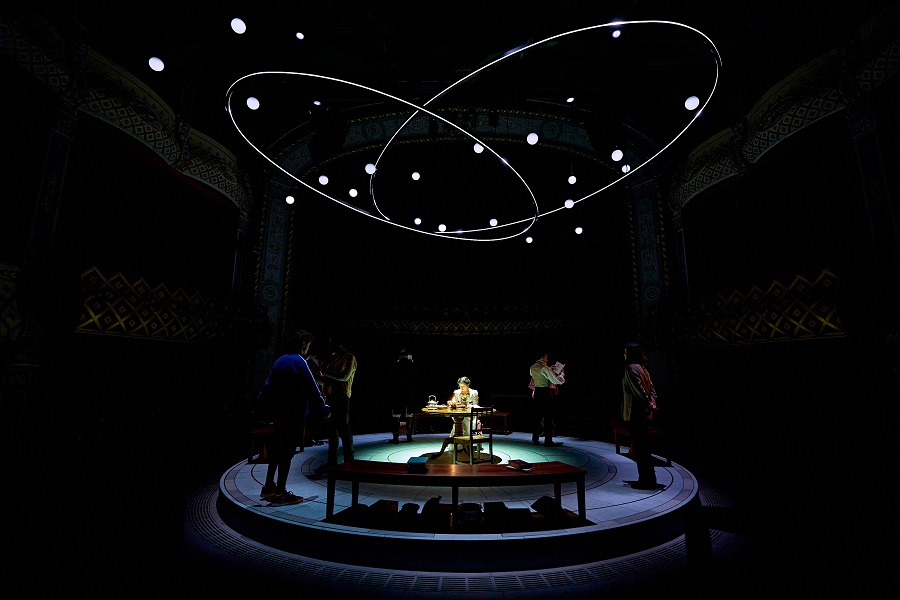
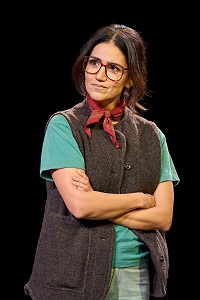
This is writer, Hannah Jarvis (Leila Farzad) and academic Bernard Nightingale (Prasanna Puwanarajah) who are also in the same room, albeit 180 years apart. She is researching the story of a garden hermit, who lived in the grounds of Sidley Park for 22 years while he wishes to uncover a scandal around the poet Lord Byron who was also there.

As the story unfolds, the time structure of scenes in the present and the past occur one after the other. So, this means that the audience know more of what is going on than the protagonists in each of the time frames and that feels hugely satisfying.
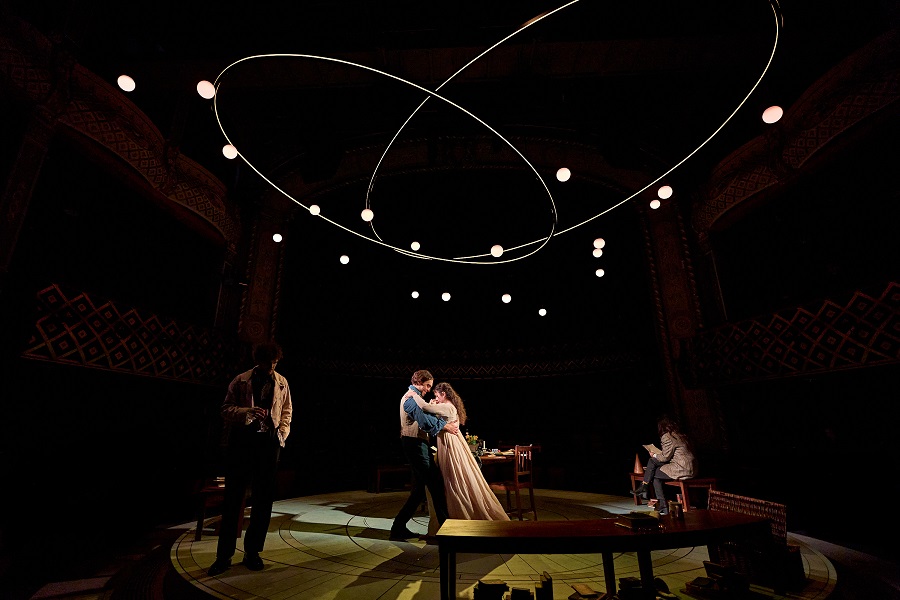
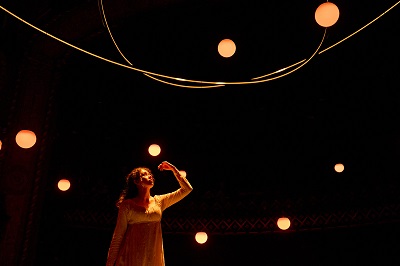
Designed by Alex Eales, with lighting by Guy Hoare and directed by Carrie Cracknell, the show is staged is in the round with the audience sitting around the 360 degree circumference of the stage. Above their heads, hangs a model of the universe and the stars. The set has minimal furniture and has period costume as appropriate. ‘Arcadia’ spills over with concepts and characters and the show is spellbinding.
In the 19th century is the house is being remodelled from a classically landscaped style into a romantic gothic wilderness or “arcadia” as part of the new fashion by landscape artist, Richard Noakes (Gabriel Akuwudike). It’s a weekend and guests have been invited to stay by Lady Croom (Fiona Button -Thomasina’s mother) and there is a lot of sexual shenanigans going on off stage. The poet, Ezra Chatter (Matthew Steer) has been cuckolded by Hodge and is called out to a duel.
In the present, Nightingale – a pompous and egotistical academic wrongly assumes that Lord Byron killed Chatter and then fled. However, just like a good detective story little by little, the pieces come together.
Also in the present day, Valentine (Angus Cooper), a descendant of Thomasina Coverly and a maths graduate, is doing his own project of understanding the grouse population of the estate.
He comes across some of Thomasina’s geometric workings and the realisation dawns that what she was doing was trying to identify chaos theory and the second law of thermodynamics, even before it became scientific enquiry.
There are many big scientific ideas in ‘Arcadia’ but it is ultimately about human beings and their relationships to each other. And it is about the curiosity of human enquiry.
In the play, notions are ping-ponged across time zones, the people in the present trying to make sense of the past (albeit, incorrectly sometimes). The chemistry between the two sets of couples is engrossing.

Septimus and Thomasina share a mutual respect and it is clear that the teenager has a crush on her tutor. For Hannah and Bernard, it is more a prickly intellectual rivalry and he is a vain and selfish man who gets his comeuppance.
The final scene is beautiful to watch. As we reach Thomasina’s 17th birthday, she asks her tutor to teach her to waltz and this scene is romantic and seductive with sad undertones.
Both time zones feature a tortoise and you wonder if this is Stoppard having the last laugh, as tortoises are reputed to have long lives, thus making the reptile a live link from the past to the present.
There are fine performances, it’s mesmerising, appealing to the heart and the head.
ACV rating: **** (out of five)
All pictures: ©ManuelHarlan
*Tom Stoppard passed away in November last year, aged 88.
**Fermat’s Last Theorem was a well-known mathematical puzzle that was only resolved in 1994-95.
Listings
‘Arcadia’ by Tom Stoppard until Saturday (March 21) – The Old Vic, The Cut, London SE1 8NB
More info/tickets: https://www.oldvictheatre.com/stage/arcadia/