‘Sholay’ live: The Meeting of Cultures, musically – conductor Melvin Tay on this, Orchestral Qawwali Project and AR Rahman
One of the best known Bollywood films ever made gets a live musical rendering and Melvin Tay talks about the musical challenges, his work with Rushil Ranjan and Abi Sampa and that incredible spring concert at the Royal Albert Hall, when the icon that is AR Rahman (see our Reel below) made his debut there with the three of them…
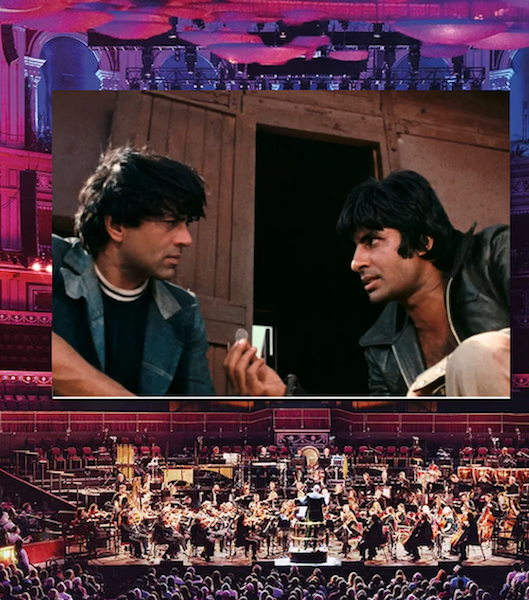
IT IS not every day that one of Indian cinema’s most cherished films gets the full Royal Albert Hall (RAH) treatment – giant screen, restored print, subtitles, and a live orchestra breathing fresh life into what is regarded these days as an eternal Bollywood classic.
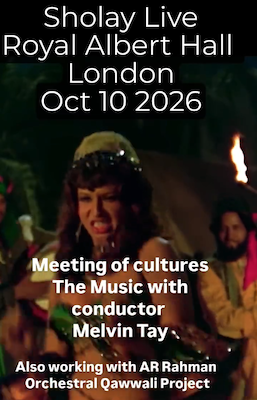
Tomorrow (October 10), ‘Sholay‘ arrives at the Royal Albert Hall as a Films in Concert world premiere, with the Royal Philharmonic Concert Orchestra conducted by Melvin Tay performing RD Burman’s indelible score live to screen.

The film will be presented as ‘Sholay: The Final Cut’, the restored 4K version that reinstates material removed by Indian censors on its original release in 1975, projected in Hindi with English subtitles.
For Tay, who conducts a lot of film-with-orchestra concerts, this one has meant a deep dive not only into a landmark film, but also into a sound world in which Hindi cinema, Hindustani colours, western orchestral writing and Bollywood soundscapes all collide.
“When they first approached me to do ‘Sholay’, I have to admit, ‘Sholay’ was quite new to me,” Tay, who grew up in Singapore, told www.asianculturevulture.com. “But I think I’ve watched this film so many times now – and it’s brilliant. It makes so much sense why it’s so iconic. I really love it.”
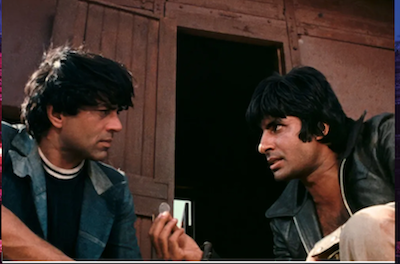
Many will know ‘Sholay’ as the all-action, all-emotion story of Jai (Amitabh Bachchan) and Veeru, (the late Dharmendra) of Gabbar Singh (Amjad Khan) and Thakur (Sajeev Kumar), of Basanti, (Hema Malini) Radha (Jaya Bachchan), revenge, friendship and dialogues that passed into everyday speech. Two low-level hoodlums Jai and Veeru are enlisted by a police chief to take on a much feared bandit… along the way, they find love, companionship and courage.
The practical challenge of arranging the music has been formidable.
This was never created as a live concert version. The production has had to reconstruct and re-orchestrate the music, so it can sit with the film in the unforgiving precision of live-to-picture performance.
Tay credits esk, the production studio, and orchestrator James Hamilton with the painstaking work of listening back to the original tracks and rebuilding the orchestra parts. Indian music consultant Ranjana Ghatak has also helped identify the sounds and instruments that best serve the score on stage.
“Some of the sounds are quite hard to tell because of the way it was recorded,” Tay said. “The original recording is quite old, so some of the quality of the sound is very hard to tell – is it that instrument or another instrument? Ranjana was helping with trying to figure out which instrument would suit best in the live context,” explained Tay.
There are six musicians joining the Royal Philharmonic Concert Orchestra for ‘Sholay’ tomorrow.
They are listed on the RAH website as Janan Sathiendran, Kirpal Panesar, Ram Siva, Rikhil Raithatha, Soumik Datta and Kaviraj Singh.
Tay sees them as central to the meeting of traditions at the heart of the evening.
“It’s a meeting of cultures, really,” he said. “Musicians coming from different music traditions and a slightly different way of working, in terms of performing music, coming together.”
Tay, speaking to acv last week, was set to continue to meet the specialist Indian musicians before any full rehearsal, then bring them together with the orchestra.
The vocal tracks, he said, remain the original singers’ voices, allowing the live performance to sit around those irreplaceable recordings.
“They managed to get just the vocal tracks from the original studio,” Tay explained. “So we just got those vocal stems, and then we are performing to that.”
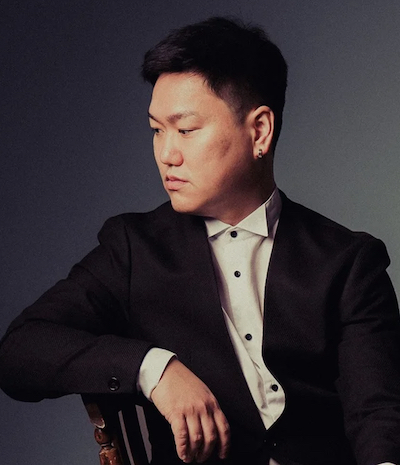
Tay takes centre stage also in a fortnight too (October 24) to conduct the Orchestral Qawwali Project.
RAH associate artists – Rushil Ranjan and Abi Sampa have crafted a new way of performing Qawwali. Originally, a group of singers would turn Persian and Urdu poetry into lyrics and perform as a small group of vocalists backed by a handful of traditional musicians.
The form originated with the poet, scholar and musician Amir Khusrow in the 13th century around Delhi and was massively popularised by Nusrat Fateh Ali Khan (1948-1991) in the 20th century in the West.
Ranjan, in a filmed interview with us last year (see link below), remarked on what an influence Khan had been on his own musical development and how Qawwali with an orchestra and performing in large spaces became their speciality and led to them being made associate artists early last year. Ranjan and Sampa had different musical paths and came together for Qawwali – with the couple marrying and having a young child now.
Tay has been closely associated with the project for more than a couple of years.
He first met Ranjan when the composer was looking for an orchestra to record ‘Rubaru’, a Qawwali written with Sampa. “I was the conductor for the orchestra,” Tay recalled. “We met there and then we clicked.”
That led to performances at the Roundhouse, Bradford Literature Festival, and eventually the Royal Albert Hall two years ago. For Tay, Qawwali was initially a discovery made through the artists themselves.
“They were the ones that really introduced me to Qawwali,” he told acv. “After working with them for the first time, I went listening to different Qawwali groups. It’s just so high energy. You don’t realise how the time passes – and then the next moment I’m like, ‘Oh, I’ve been here for three hours.’ There is so much power in the way they sing it.”
Earlier this year, Tay was also part of AR Rahman’s Royal Albert Hall show with Ranjan – a huge occasion for South Asian music in one of Britain’s most historic venues.
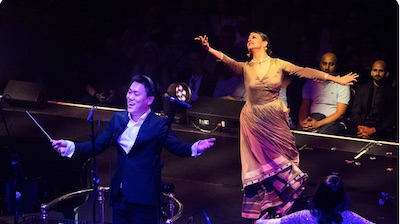
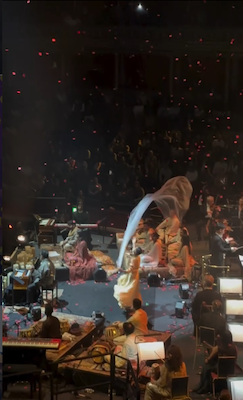
He describes that experience as almost other worldly – many in the hall felt it so, with Aakash Odedra dancing an excerpt of his award-winning piece, ‘Songs of the Bulbul’ (see the reel below) and AR very much leading the way.
There hadn’t been a lot of time to talk and discuss the musical arrangements.
“It was one of those experiences that was quite surreal,” Tay said. “There was so much work involved in putting it together that we were just so focused. When we got there, it all fell into place because we had all put so much effort into it.”
Working with Rahman also offered a close-up view of how a composer thinks about music that has travelled across generations and continents.
“It was interesting to see the way he worked, the way he thought about the music he had written,” Tay said. “We did ‘Bombay Dreams’ (in the West End, 2002-4) and it was lovely to see that process.”
The October 24 Orchestral Qawwali Project will be different, Tay stresses, from the Rahman concerts (April 24-26) – they played both at the Royal Albert Hall and then again in Toronto, two weeks later.
This is Ranjan and Sampa’s world, with Qawwali at its centre and new work at its heart.
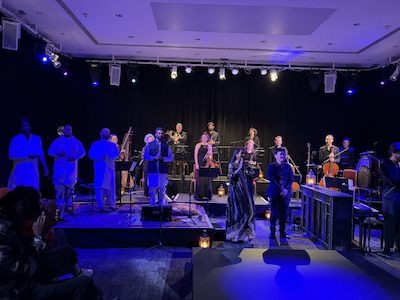
“It’s going to be equally as epic,” Tay reflected, “but it’s all going to be works written by Rushil and Abi. It will feature some of the big hitters they have put out before, but I know he is writing a whole bunch of new music.”
For Tay, conducting is less about the mystique of the podium than the task of bringing people together.
Born in Singapore, he moved to the UK in 2013 to study music, and found in conducting a way to collaborate with many musicians at once.
“I really wanted to be in a room making music with people and performing – basically bringing people together,” he said. “For ‘Sholay‘, I get to work with all the incredible soloists on stage.
“For OQP, I get to work with Abi, with Janan on tabla, with Rushil writing new music. It’s the ability to pull different threads together.”
And perhaps that is the link between these two October nights: a 1975 Bollywood epic reborn through orchestra, and a devotional tradition expanded into symphonic scale. Different histories, different energies, but the same idea – music made larger by a coming together and a new iteration of timeless classics.
Click to view
LISTINGS
There are still some tickets for ‘Sholay’ tomorrow (October 10)
6.30pm Film starts (restaurant and bars open from 4.30pm; hall opens 5.30pm) Royal Albert Hall, Kensington Gore, South Kensington London SW7 2 AP
More info/listings: https://www.royalalberthall.com/tickets/events/2026/sholay-in-concert
Orchestral Qawwali Project
Saturday, October 24 address same as above…
More info https://www.royalalberthall.com/tickets/events/2026/orchestral-qawwali-projectutm_source=Google&utm_medium=paidsocial&utm_campaign=orchestral-qawwali-project-2026&utm_id=orchestral-qawwali-project-2026&gad_source=1&gad_campaignid=23863206604&gclid=CjwKCAjwoaLWBhAWEiwAnyitu5EIDOZYw21fs5RcC7K61JLEo-JZq_3fIzU7GAWgHlDiiIR0Sm7UBBoCwtkQAvD_BwE
Tickets: https://tickets.royalalberthall.com/syos2/performance/102550